I've been thinking a lot about Star Wars this week… and about the “controversy” around The Last Jedi.
First, let’s get this out of the way: we're a bunch of nerds arguing about a movie series. This is the very definition of “first world problem” and none of this really matters. Second, it’s OK to dislike TLJ, just as it is OK to love it. Third, I didn't hate The Last Jedi, but I didn't love it either… and that's what everyone is talking about, so I might as well too.
Here’s my thesis about the problem with the new Star Wars trilogy: it needed a “show runner”. Bear with me as I lay out my case.
The prequels (Ep I - III) have a better story. They are not good movies, but they have an amazing plot. If George had let others (like Kasden) craft the scripts and dialogue, and there had been better acting, they could have been amazing. The story was there, but poorly executed. I also posit that their importance is because of Palpatine’s story, not Vader’s. Anakin was a patsy. Palpatine was one bad-ass motherf@#%$!... But I'm straying off-point.
The point is that Lucas had a vision of the Machiavellian machinations which would lead a Senator of a back water planet to become Emperor of the Galaxy. Palpatine was playing a literal long game. Encouraging a civil war. Setting up the clones. Making his planet a victim so he could rise from obscurity. This shit had layers upon layers. It was an amazing idea ruined by terrible scripts… But the idea was there. A single over-arcing plot to tie the 3 movies together (even if it was poorly executed).
Saturday, December 23, 2017
Wednesday, December 13, 2017
Best Board Games for the Nascent Board Gamer
So, I recently ran across a “Best Five Board Games” list made by some random website that appears to have no actual experience with board gaming. Their picks were utterly sad and pathetic, including the likes of Monopoly, Life, and Candy Land.
If you’re an avid board gamer, you probably already have a “gateway game” list to play with those friends who are not in your normal board game group… but here is my take on the best introductory games, simply because I have a gaming blog and the more we spread the word, the better. The list, in no particular order…
This set collection and puzzle game is light enough for the novice gamer, but has some real strategic meat on its bones. In Alhambra ($25), you collect gardens, pavilions, and various building tiles to expand and beautify your 13th century fortress. Money management is critical as you gain bonus purchases for paying the exact amount for a tile. The player who has collected the most of specific tiles sets over the course of 3 rounds will score the points for a win.
Originally published in 1995 as “Settlers of Catan”, this resource management and building game kick-started the board gaming renaissance. Over 20 years later, Catan ($35) is in its 5th Edition with numerous expansions and spin-offs. In Catan, you collect the resources of brick, wheat, ore, wood, and wool in order to expand your settlements to become cities.
This “gateway” game is easy to teach in that you can compare it to existing popular games like Monopoly. You build “Settlements” instead of Houses and upgrade to “Cities” instead of Hotels. Expanding your road system onto valuable resource tiles is key, similar to expanding the number of properties in that other game. Players who have grown up on Hasbro and Parker Brothers will find a familiar home in Catan, but with a much greater depth of play (and hopefully fewer fits of crying).

Codenames borders on the “party game” genre, but I honestly love this game and everyone to whom I have introduced this game has also loved it. For around $12, what’s not to love? In summary, you give clues to your teammates in order for them to make the word associations and select one or more cards, while trying to avoid selecting the other team’s cards. I believe Codename: Pictures is slightly superior in that there are a lots of clue variations that will arise due to the esoteric artwork (which is the same reason I also enjoy the next pick).
If you’re an avid board gamer, you probably already have a “gateway game” list to play with those friends who are not in your normal board game group… but here is my take on the best introductory games, simply because I have a gaming blog and the more we spread the word, the better. The list, in no particular order…
Alhambra
This set collection and puzzle game is light enough for the novice gamer, but has some real strategic meat on its bones. In Alhambra ($25), you collect gardens, pavilions, and various building tiles to expand and beautify your 13th century fortress. Money management is critical as you gain bonus purchases for paying the exact amount for a tile. The player who has collected the most of specific tiles sets over the course of 3 rounds will score the points for a win.
Catan 5th Edition
Originally published in 1995 as “Settlers of Catan”, this resource management and building game kick-started the board gaming renaissance. Over 20 years later, Catan ($35) is in its 5th Edition with numerous expansions and spin-offs. In Catan, you collect the resources of brick, wheat, ore, wood, and wool in order to expand your settlements to become cities.
This “gateway” game is easy to teach in that you can compare it to existing popular games like Monopoly. You build “Settlements” instead of Houses and upgrade to “Cities” instead of Hotels. Expanding your road system onto valuable resource tiles is key, similar to expanding the number of properties in that other game. Players who have grown up on Hasbro and Parker Brothers will find a familiar home in Catan, but with a much greater depth of play (and hopefully fewer fits of crying).
Codenames / Codenames: Pictures

Codenames borders on the “party game” genre, but I honestly love this game and everyone to whom I have introduced this game has also loved it. For around $12, what’s not to love? In summary, you give clues to your teammates in order for them to make the word associations and select one or more cards, while trying to avoid selecting the other team’s cards. I believe Codename: Pictures is slightly superior in that there are a lots of clue variations that will arise due to the esoteric artwork (which is the same reason I also enjoy the next pick).
Friday, December 8, 2017
Owlbear's D&D Holiday Gift Guide
The holidays are here, so you might be wondering what to get your gaming friends (or, let’s be honest… probably a little gift for yourself). The great news is that there is a whole plethora of D&D-related gifts for a wide variety of diverse gaming interests. [Updated for 2018]D&D RPG
The recent release schedule has had quite an array of books for the tabletop gamer. For players and Dungeon Masters alike, Xanathar’s Guide to Everything ($30) includes 32 new class paths and new spells for PCs, as well as offering an array of of advice for DM’s on encounter building, proficiencies, traps, and downtime activities. Volo’s Guide to Monsters ($34) gives DM’s new variants of classic, iconic monsters as well as includes other fantastic creatures that didn’t quite make it into the Monster Manual.
The most recent adventure offerings have included a variety of adventuring locales for gaming groups with a variety of play styles.Storm King’s Thunder ($34) is sprawling Sword Coast campaign crossing the wilds of Faerun from Waterdeep to Anauroch and nearly all places in between. This sandbox-like adventure path has multitude of hooks and side quests all over its massive Sword Coast map.
Tales from the Yawning Portal ($34) brings back old-school dungeon crawls from prior editions, updating them for D&D 5th Edition. Classics include the Hidden Shrine of Tamoachan, the Sunless Citadel, White Plume Mountain, and the infamous Tomb of Horrors.Tomb of Annihilation ($34) provides a Chultan hommage to the classic Isle of Dread and Tomb of Horrors adventures, updating the hex crawl style campaign for 5th Edition, as well as throwing in some old-school death.
Waterdeep and Undermountain reappear in 5th Edition with Waterdeep: Dragon Heist and Dungeon of the Mad Mage. Lead the chase for a vast treasure within the City of Splendors or delve the darkness beneath the Yawning Portal.
For fans of Critical Role, you can now play in Matthew Mercer’s world, the Tal'Dorei Campaign Setting (apostrophes included at no extra charge) for $26.
Or if Tolkien is more your thing, Cubicle 7 has converted its One Ring game to D&D 5th Edition rules with Adventures in Middle Earth. If you've wanted to play a low fantasy version of D&D, especially set in Tolkien's universe, this is probably right up your alley.In the accessories category, there is the newly revised Dungeon Master's Screen Reincarnated ($10), the thick, folding cardboard D&D Adventure Grid (more than just a battle mat at $20) and the venerable, but still available D&D Dungeon Tiles: Wilderness Master Set ($18), soon to be reprinted along with the Dungeon and City master sets.
If you’re playing on the grid, you may want to pick up some D&D Icons of the Realms or Pathfinder Battles miniatures… and for the DM who has everything, there is the massively, huge D&D Board Games
But it’s not all about D&D role-playing. Wizards of the Coast has expanded the brand into some really amazing board games.
![]() |
| Wrath of Ashardalon miniatures |
The Temple of Elemental Evil version introduced campaign play, which the prior versions lacked. However, Wrath of Ashardalon probably comes with the best variety of miniatures, including an amazing Huge Red Dragon. Not only are theses fun dungeon crawl board games, the miniatures themselves make these games a fantastic value if you also play D&D tabletop.
Assault of the Giants takes on the area-control board game with asymmetric play and features a beautiful Sword Coast game board and over a dozen giant miniatures. Even though the giant miniatures are not as large as the Icons of the Realms miniatures, they are still sizable enough for rpg play in a pinch. This also comes in a painted miniature premium version.
Betrayal at Baldur’s Gate reskins a D&D theme onto Betrayal at the House on the Hill. Fans of the original will almost certainly like this version (full review here).
Dragonfire brings Catalyst Games’ Crossfire deck-builder mechanics into the D&D world. This game not only offers cooperative deck building, you can also play campaign scenarios that allow your characters to progress similar to a legacy game. I will have to opportunity to play this title more extensively this weekend and I’m looking forward to seeing how it fares. Fans of the Shadowrun Crossfire game are bound love this D&D themed version.Tyrants of the Underdark combines deck building with area control in an Underdark themed game board (my initial review here). Like other deck builders, you mix and match cards from different factions to give the game a huge replayability factor.
There are multiple paths to victory and the lead can swing wildly from player to player across turns. Victory points at the end are almost always very close, making the game play exciting to the very last turn. This is one of the top board games in my collection, and probably ranks just behind Roll for the Galaxy as my favorite.
Lords of Waterdeep along with its expansion Scoundrels of Skullport provide a solid worker-placement board game. Though it is now several years old, it is still in print and is well regarded even among the most jaded board gamers. This is also a great “gateway” board game for D&D groups that may not be as into the board game scene.
D&D Adjacent Games
Though not strictly D&D themed, there are several fantasy games that give a similar flavor.
If you are lucky enough to live near a 5 Below thrift store, keep an eye out for Magic the Gathering: Arena of the Planeswalkers for only $5 ($10 - $12 on Amazon)! This Heroscape-based game uses characters and creatures from the Magic the Gathering universe in an entertaining, squad-based miniatures skirmish game. But the best part is that it come with 35 miniatures. That’s a fantastic value at $5 or even $10.
It’s $5 expansion, Battle for Zendikar come with another 16 miniatures. That over 50 miniatures for between $12 to $18!!! If you are really lucky, you can also find Shadows over Innistrad for less than $10 and add another 25 figures to that total! Hell, even if you hate skirmish board games, you can pick up 75 miniatures for under $30… and the game is pretty fun, too!
While not quite the stunning Planeswalker deal, Zombicide: Black Plague offers a zombie apocalypse with fantasy flavor. Zombicide has been so popular that it has generated many expansions, but this stand-alone version is probably the best, especially if you like the fantasy theme.
Speaking of fantasy re-themes, Defenders of the Realm generates the race-against-the-clock excitement of games like Pandemic, but instead of fighting disease, you are fighting orcs and dragons!
And lastly, I’d be remiss if I didn’t mention one of the old-timer dungeon crawlers, Descent: Journeys in the Dark and its many expansions. Descent now includes an app from Fantasy Flight that allows all the players to play cooperatively against the game without the Overlord player. (Imperial Assault offers a similar dungeon-crawl-slash-race-against-the-clock experience, but in the Star Wars universe).
Final Thoughts
We're definitely in a golden age of gaming. Between D&D and other fantasy rpgs and board games, there are dozens of ways to get your fantasy kicks this year.
Thursday, November 30, 2017
Board Games: Owlbear Reviews Betrayal at Baldur's Gate
With Betrayal at Baldur's Gate, Avalon Hill has expanded the array D&D themed board games published this year. When placed alongside Assault of the Giants (review pending), Dragonfire, and the Tomb of Annihilation board games (as well as prior year offerings such as Tyrants of the Underdark), there is quite a variety of play style offerings in 2017 for D&D board game enthusiasts. If you are already familiar with Betrayal at the House on the Hill, Betrayal at Baldur's Gate will be super easy to pick up.
Like its predecessor, the players move around revealing the board one tile at a time while encountering Events, gaining Items, and discovering Omens. Eventually, the Haunt is revealed which determines the win conditions for the traitor (usually one player) and the heroes (everyone else).
Full disclosure: I have only had the chance to play a couple of haunt scenarios in the new Betrayal at Baldur's Gate, so you might want to keep that in mind when you consider my evaluation.
First, I'll start with what I really enjoy about the game.
The new characters all have a special power, like a spell, or ranged attack, or re-roll mechanic for example. This gives each character a bit more flavor and adds to the already high replay factor.
The D&D theme is well done in terms of the scenarios, events, flavor text, etc. I wasn't sure a thematic mashup of Betrayal and D&D would work, but so far, so good. Also, there are quite a few D&D in-jokes and Easter Eggs sprinkled throughout the game tiles and text for those with an eye for detail.
The new haunt roll mechanic also ensures that the haunt cannot happen prior to the 3rd Omen card. Unfortunately, you can't read through the haunts without spoiling them, so I don't have enough data to know how well they fit the theme. However, in one play test, the haunt involved all players versus the game. There was no traitor, and working together to beat the boss monster gave a familiar D&D feel.
I do like the way the buildings and streets combine to make a large "ground level" map, with a smaller catacombs level. I also like that each level has its own draw pile. In the original, a critical room can often be accidentally "buried" at the bottom of the draw pile because of the way the draw mechanic works. This does not occur in the new version.
The sex pre-painted miniatures are also pretty nice and, as a bonus, are sized appropriately for D&D table top.
That said, one of my biggest complaints with the various Betrayal games (the original, Widow's Walk, and now this one) is that the scenarios do not appear to be play tested very well, or well edited in some cases.
How do I know?
We almost always have questions about the traitor powers or actions within the haunt. And I'm not just talking about minor questions, but almost always key issues with the way the powers are worded that make the haunt rules overly ambiguous.
My wife and I are veteran gamers. We have played the different Betrayal games as well as other traitor-mechanic games like Shadows over Camelot, Battlestar Galactica, Dead of Winter, etc... The design challenge with the Betrayal games over other traitor mechanic games is that every scenario has slightly different rules for the traitor and heroes. Because of this, the game designers need to be extraordinarily detail-oriented when writing up the haunt rules.
Due to the age of the original Betrayal game, haunt clarifications can sometimes be found online, but not so for Widow's Walk or Baldur's Gate, so you are on your own to interpret the rules as written.
For the hero group, the players can generally come to a consensus after discussion if there are any doubts. However, the traitor is usually on their own to interpret any potential rule problems or vague wording, unless they want to give away their secret powers or victory conditions.
I have yet to play a haunt that hasn't had an issue where the text was not entirely clear and required some varying amount of interpretation. In almost every case, a single sentence (or two at most) would have cleared up the confusion. A good editor should have caught these ambiguities, but I have the distinct impression the the designers did their own editing... or if there was an editor, the editor was only looking for grammatical issues, and not rules ambiguity. A play test of each haunt should haven eliminated most of these problems.
All boards games have some amount of rules vagueness that often need a forum, faq or site like Board Game Geek to help, but it is more pronounced in the Betrayal games simply because there are some 30 to 40 different haunts that all may have different issues, and you are not able to read the haunt rules in advance without spoiling the game.
This has been a big problem for me in that any win or loss is tainted by the "Hey, did we play that part correctly?" discussion after the game. It often takes away some of the shine of a win, or adds to the frustration of a loss. I don't mind losing. Losing a competitive game can be lots of fun. But I hate losing when it later becomes clear that an incorrectly interpreted rule may have changed the whole scenario or player strategy.
As a non-spoiler example, one of the haunts had a big monster with some smaller minions. The minions came out first, and the big boss a couple turns later. In the haunt, it appears to state that the minions go away once the boss monster comes out, but a sentence or two later, it implies the exact opposite. Within the same haunt, the text appeared to imply that the boss monster may be able to attack more than one character given certain conditions, but it didn't explicitly state it. As a group, we ruled that the minions stayed and continued to attack, but the boss monster did not attack more than once. That seemed to be the most balanced interpretation, and we won the scenario... but we may not have won if the boss monster were allowed a second attack, so the victory felt diminished given that we still don't know what the correct ruling is. Since that we had not just one, but two rules clarifications required for the haunt, I was a bit disappointed in that particular scenario, and that has tainted my view of the game for the moment.
Don't get me wrong. I don't dislike the game. If you are a fan of the other Betrayal titles and you like D&D, you will almost certainly enjoy this mash up. However, my recent experiences with poorly worded haunts in the various Betrayal incarnations has tarnished what would otherwise be a really fun experience. It may be that I'm pre-judging Baldur's Gate too hard based upon the play experience with the other Betrayal titles. But it does not bode well that one of the first haunts I encountered had the same problem.
I would give it 3.5 stars of 5. It's a strong Buy recommendation for fans of the Betrayal line, but if you are also annoyed by rule ambiguities of the haunts in the other titles, you will likely find the same issues in this one. The great news is that there are plenty of D&D themed board games to choose from if this one is not your cup of tea.
Like its predecessor, the players move around revealing the board one tile at a time while encountering Events, gaining Items, and discovering Omens. Eventually, the Haunt is revealed which determines the win conditions for the traitor (usually one player) and the heroes (everyone else).
Full disclosure: I have only had the chance to play a couple of haunt scenarios in the new Betrayal at Baldur's Gate, so you might want to keep that in mind when you consider my evaluation.
The Pros
First, I'll start with what I really enjoy about the game.
The new characters all have a special power, like a spell, or ranged attack, or re-roll mechanic for example. This gives each character a bit more flavor and adds to the already high replay factor.
The D&D theme is well done in terms of the scenarios, events, flavor text, etc. I wasn't sure a thematic mashup of Betrayal and D&D would work, but so far, so good. Also, there are quite a few D&D in-jokes and Easter Eggs sprinkled throughout the game tiles and text for those with an eye for detail.
The new haunt roll mechanic also ensures that the haunt cannot happen prior to the 3rd Omen card. Unfortunately, you can't read through the haunts without spoiling them, so I don't have enough data to know how well they fit the theme. However, in one play test, the haunt involved all players versus the game. There was no traitor, and working together to beat the boss monster gave a familiar D&D feel.
I do like the way the buildings and streets combine to make a large "ground level" map, with a smaller catacombs level. I also like that each level has its own draw pile. In the original, a critical room can often be accidentally "buried" at the bottom of the draw pile because of the way the draw mechanic works. This does not occur in the new version.
The sex pre-painted miniatures are also pretty nice and, as a bonus, are sized appropriately for D&D table top.
The Big Con
That said, one of my biggest complaints with the various Betrayal games (the original, Widow's Walk, and now this one) is that the scenarios do not appear to be play tested very well, or well edited in some cases.
How do I know?
We almost always have questions about the traitor powers or actions within the haunt. And I'm not just talking about minor questions, but almost always key issues with the way the powers are worded that make the haunt rules overly ambiguous.
My wife and I are veteran gamers. We have played the different Betrayal games as well as other traitor-mechanic games like Shadows over Camelot, Battlestar Galactica, Dead of Winter, etc... The design challenge with the Betrayal games over other traitor mechanic games is that every scenario has slightly different rules for the traitor and heroes. Because of this, the game designers need to be extraordinarily detail-oriented when writing up the haunt rules.
Due to the age of the original Betrayal game, haunt clarifications can sometimes be found online, but not so for Widow's Walk or Baldur's Gate, so you are on your own to interpret the rules as written.
For the hero group, the players can generally come to a consensus after discussion if there are any doubts. However, the traitor is usually on their own to interpret any potential rule problems or vague wording, unless they want to give away their secret powers or victory conditions.
I have yet to play a haunt that hasn't had an issue where the text was not entirely clear and required some varying amount of interpretation. In almost every case, a single sentence (or two at most) would have cleared up the confusion. A good editor should have caught these ambiguities, but I have the distinct impression the the designers did their own editing... or if there was an editor, the editor was only looking for grammatical issues, and not rules ambiguity. A play test of each haunt should haven eliminated most of these problems.
All boards games have some amount of rules vagueness that often need a forum, faq or site like Board Game Geek to help, but it is more pronounced in the Betrayal games simply because there are some 30 to 40 different haunts that all may have different issues, and you are not able to read the haunt rules in advance without spoiling the game.
This has been a big problem for me in that any win or loss is tainted by the "Hey, did we play that part correctly?" discussion after the game. It often takes away some of the shine of a win, or adds to the frustration of a loss. I don't mind losing. Losing a competitive game can be lots of fun. But I hate losing when it later becomes clear that an incorrectly interpreted rule may have changed the whole scenario or player strategy.
As a non-spoiler example, one of the haunts had a big monster with some smaller minions. The minions came out first, and the big boss a couple turns later. In the haunt, it appears to state that the minions go away once the boss monster comes out, but a sentence or two later, it implies the exact opposite. Within the same haunt, the text appeared to imply that the boss monster may be able to attack more than one character given certain conditions, but it didn't explicitly state it. As a group, we ruled that the minions stayed and continued to attack, but the boss monster did not attack more than once. That seemed to be the most balanced interpretation, and we won the scenario... but we may not have won if the boss monster were allowed a second attack, so the victory felt diminished given that we still don't know what the correct ruling is. Since that we had not just one, but two rules clarifications required for the haunt, I was a bit disappointed in that particular scenario, and that has tainted my view of the game for the moment.
Final Thoughts
Don't get me wrong. I don't dislike the game. If you are a fan of the other Betrayal titles and you like D&D, you will almost certainly enjoy this mash up. However, my recent experiences with poorly worded haunts in the various Betrayal incarnations has tarnished what would otherwise be a really fun experience. It may be that I'm pre-judging Baldur's Gate too hard based upon the play experience with the other Betrayal titles. But it does not bode well that one of the first haunts I encountered had the same problem.
I would give it 3.5 stars of 5. It's a strong Buy recommendation for fans of the Betrayal line, but if you are also annoyed by rule ambiguities of the haunts in the other titles, you will likely find the same issues in this one. The great news is that there are plenty of D&D themed board games to choose from if this one is not your cup of tea.
Tuesday, October 31, 2017
Raging Owlbear Interviews Chris O'Neill
Continuing my "interview series" (used very loosely) this month, I speak with Chris O’Neill, co-founder of 9th Level Games, best known for the comic RPG "Kobolds Ate My Baby!" 9th Level has also broadened its offerings in recent years with card and board games like Schrödinger's Cats, Knuckle Sammich, Bearicades, and Hot 16.
This month, 9th Level launches its newest Kickstarter, Tragedies of Middle School, a collection of tongue-in-cheek RPG horror games about the nightmarish experiences of pre-teen grade schoolers. Tragedies of Middle School includes 21 short-form storytelling RPGs, LARPS, and activities for only $10 in PDF and a mere $20 in print.
Thursday, October 26, 2017
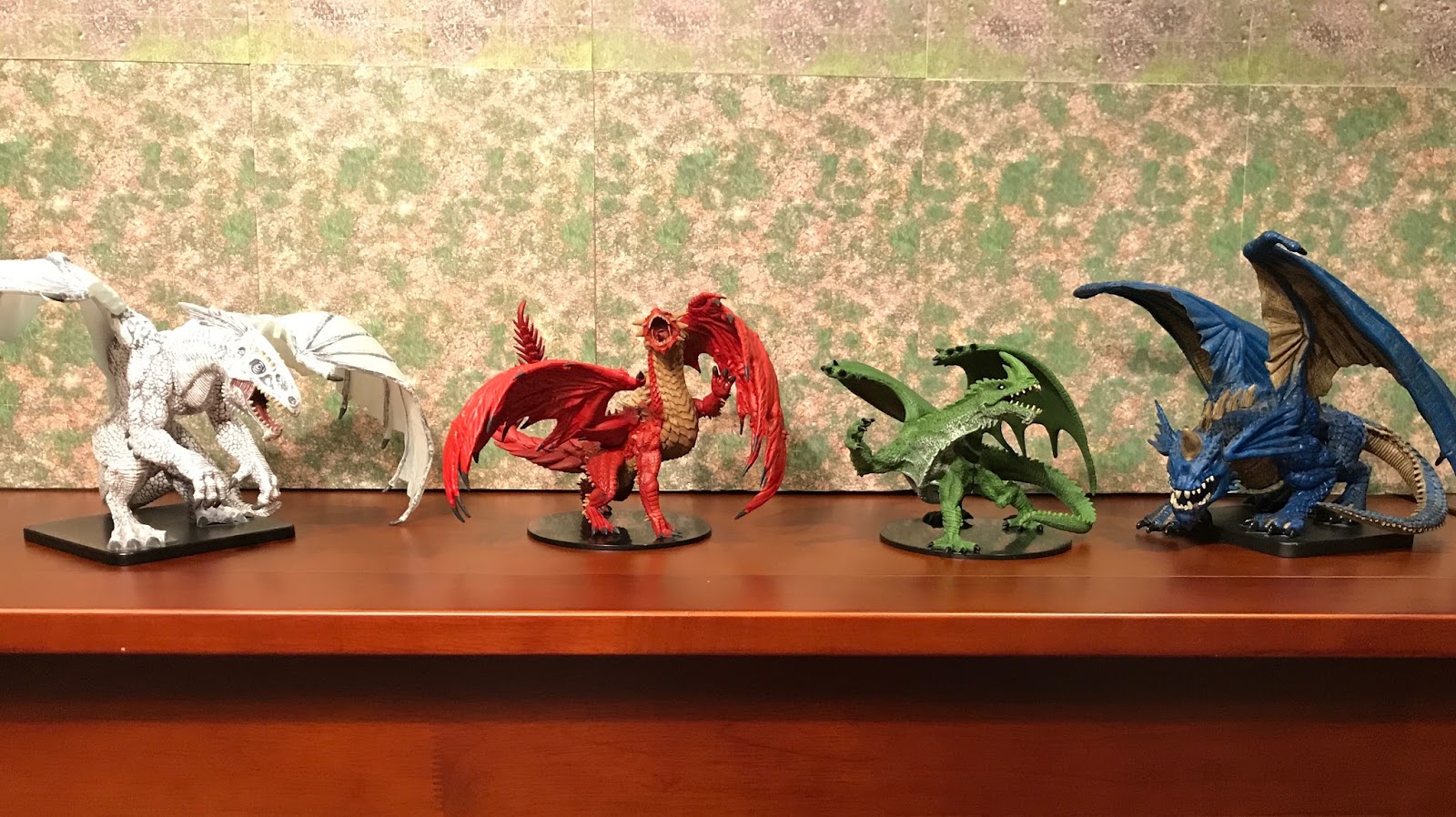
Gargantuan Dragons invade Owlbear Lair!
![]() |
| Gargantuan Red and Green Dragons from the Pathfinder Battles miniatures line. |
I was extremely surprised to see the Gargantuan Red come back in stock, and I’m pretty certain I got one of the last, if not the last one on their shelves. I had been hesitant to buy both of these models earlier due to luke warm reviews, but the Green and Red were the only chromatic dragons I did not yet have in the Gargantuan/Colossal size category. No one else, to my knowledge, has put out a pre-painted green dragon of this size, and the larger pre-painted red dragons are all ridiculously priced on the secondary markets. I kick myself to this day that I did not pick up the ICONS Colossal Red Dragon when they were only about $60!
Both models are beautifully sculpted. From an artistic standpoint, they really do stand out with very dynamic poses. However, they both suffer from what I consider a serious design flaw when it comes to tabletop play… They are both looking up. Both poses have the neck and head craning in something akin to an upward roar. From an artistic standpoint, I suppose I understand why the sculptor went in that direction, but I am disappointed that they are not looking down at the PC miniatures with an “I’m totally going to eat you!” menace.
The Gargantuan Red also has one wing folded inward in what appears to be a packaging consideration. I may try to use the heated water method to see if I can get a little bit more spread from the left wing. The painting on each is reasonably good, although I think the green dragon's color palette could have used a little more contrast.
![]() |
| The Pathfinder Battles Gargantuan Dragons are slightly smaller than the amazing WotC ICONS from 2006 - 2007. |
While these may not be my absolute favorite dragons in my collection, they are impressive models and I am glad I was able to pick these up for retail pricing. The secondary market for large dragons is quite ridiculous. Don't wait until they are gone!
![]() |
| The Gargantuans fit favorably well in size category with the huge WotC Elder Dragons from 2009 - 2010. |
Wednesday, October 4, 2017
D&D: Basics of Stealth and Hiding in 5e
![]() |
| Dragon Magazine #88 cover by Jim Holloway |
Based on recent social media chatter, it appears GM’s have some confusion when adjudicating stealth and hiding, and players believe their Rogue skills give them Advantage more than the rules as written would suggest. A re-review of the rules as written with a few examples should help.
To break this down a bit, let’s start with the rules as stated in the SRD 5.0 (bold emphasis added).
___________
Stealth
Make a Dexterity (Stealth) check when you attempt to conceal yourself from enemies, slink past guards, slip away without being noticed, or sneak up on someone without being seen or heard.
Hiding
The GM decides when circumstances are appropriate for hiding. When you try to hide, make a Dexterity (Stealth) check. Until you are discovered or you stop hiding, that check’s total is contested by the Wisdom (Perception) check of any creature that actively searches for signs of your presence.
You can’t hide from a creature that can see you clearly, and you give away your position if you make noise, such as shouting a warning or knocking over a vase. An invisible creature can always try to hide. Signs of its passage might still be noticed, and it does have to stay quiet.
In combat, most creatures stay alert for signs of danger all around, so if you come out of hiding and approach a creature, it usually sees you. However, under certain circumstances, the GM might allow you to stay hidden as you approach a creature that is distracted, allowing you to gain advantage on an attack roll before you are seen.
Passive Perception
When you hide, there’s a chance someone will notice you even if they aren’t searching. To determine whether such a creature notices you, the GM compares your Dexterity (Stealth) check with that creature’s passive Wisdom (Perception) score.
__________
So there are a few things that are implied by the above rules that could be stated more clearly, or at least clarified with examples.
Subscribe to:
Posts (Atom)
|
|